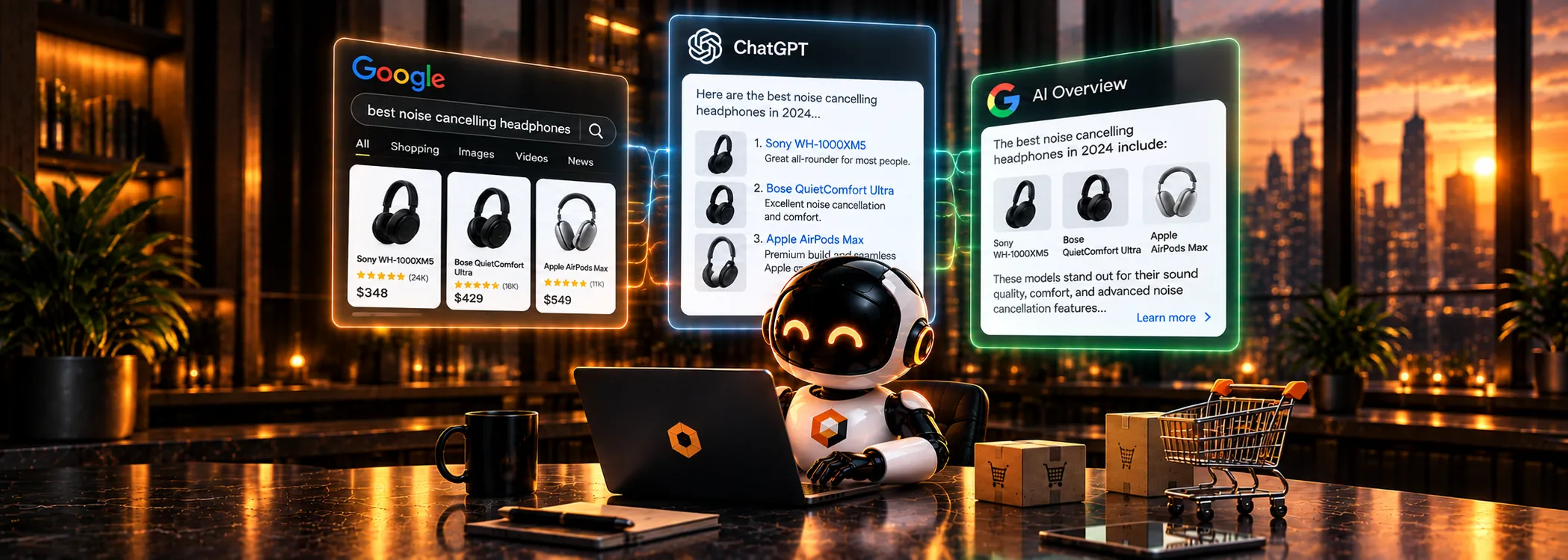

Short answer: To appear in AI shopping answers, make your product facts machine-readable and consistent. Put price, availability and key specifications in the server HTML, mark them up with Product and Offer structured data that matches the page, keep a product feed in Google Merchant Center, and answer the questions buyers ask before they buy on the product and category pages themselves.
How do AI engines build product answers?
When someone asks "best noise-cancelling headphones under $300", an answer engine searches its index, reads product and review pages, and assembles a shortlist with prices and reasons. It can only use facts it can find and trust. Three sources matter most:
- Your product pages: titles, prices, availability, specifications and descriptions.
- Structured data:
Product,Offer,AggregateRatingandReviewmarkup that states those facts explicitly. - Third-party pages: reviews, comparisons and retailer listings that mention your products.
If your price appears only after a script runs, or your specifications sit in an image, the engine has nothing reliable to quote.
What product data needs to be machine-readable?
Prices and availability in the HTML
Many stores load prices with JavaScript for currency or stock reasons. Many AI crawlers do not execute JavaScript, so they see a blank or a "loading" placeholder. We made this mistake ourselves: until September 2026 our own pricing page showed "Loading price" in the server HTML and filled in the numbers in the browser. Engines could not read our prices at all. Render a default price on the server and let the browser update it if needed.
Product structured data
Use Product with a nested Offer on every product page:
name,description,image,brand, and an identifier such asgtinorsku,offerswithprice,priceCurrency,availabilityandurl,aggregateRatingandreviewonly for real reviews shown on the page.
Structured data must match the visible content. Marking up a price the page does not show, or ratings that do not exist, breaks Google's guidelines and undermines trust.
A product feed
Google Merchant Center feeds product data to Google Shopping, including free listings. Keeping the feed accurate and in sync with your pages gives Google a second, structured view of your catalogue.
What content helps products get recommended?
AI shopping answers explain why a product fits. Give engines those reasons in plain text:
- Answer pre-purchase questions on the page: sizing, compatibility, materials, battery life, what is in the box, warranty.
- Write comparison content honestly: "X vs Y" pages and buying guides that state trade-offs, not just praise.
- Make category pages useful: a short paragraph explaining how to choose, above the product grid.
- Keep specifications in text, not images. A table of specs is easy to extract; a JPEG of one is not.
What technical SEO problems are specific to stores?
- Faceted navigation: filter combinations can create thousands of near-duplicate URLs. Control them with canonical tags and by not linking crawlable URLs for every combination.
- Out-of-stock products: keep the page live with accurate availability if the product returns; redirect only when it is gone for good.
- Duplicate descriptions: manufacturer text copied across many stores gives engines no reason to pick yours.
- Slow product pages: large images without dimensions and heavy scripts hurt both rankings and crawling.
Which crawlers need access?
Googlebot for Google Search and AI Overviews, OAI-SearchBot for ChatGPT search, PerplexityBot for Perplexity and Bingbot for Microsoft Copilot. Blocking training crawlers such as GPTBot is a separate licensing choice and does not remove you from ChatGPT search. Check your robots.txt with our free checker and see every agent in our crawler list.
What is the AEO part, and what is the SEO part?
Most of this checklist is SEO: crawlable pages, structured data, feeds, canonicals and speed. The AEO part is the writing: answering buyers' questions directly and stating facts in a way an engine can quote. Stores that only do the SEO part get indexed; stores that also do the AEO part get explained and recommended.
Frequently asked questions
Does structured data guarantee my products appear in AI answers?
No. It makes your product facts clear and trustworthy, which helps. Engines also weigh relevance, reviews and third-party mentions.
Should I show prices if they vary by country?
Show a default price in the server HTML and localise in the browser if needed. A missing price is worse than a default one.
Can I check a product page for free?
Yes. Our free page check runs structure, schema and answer-readiness checks on any URL and shows the evidence for each finding.